
Academics
Where Spanish immersion meets joyful learning
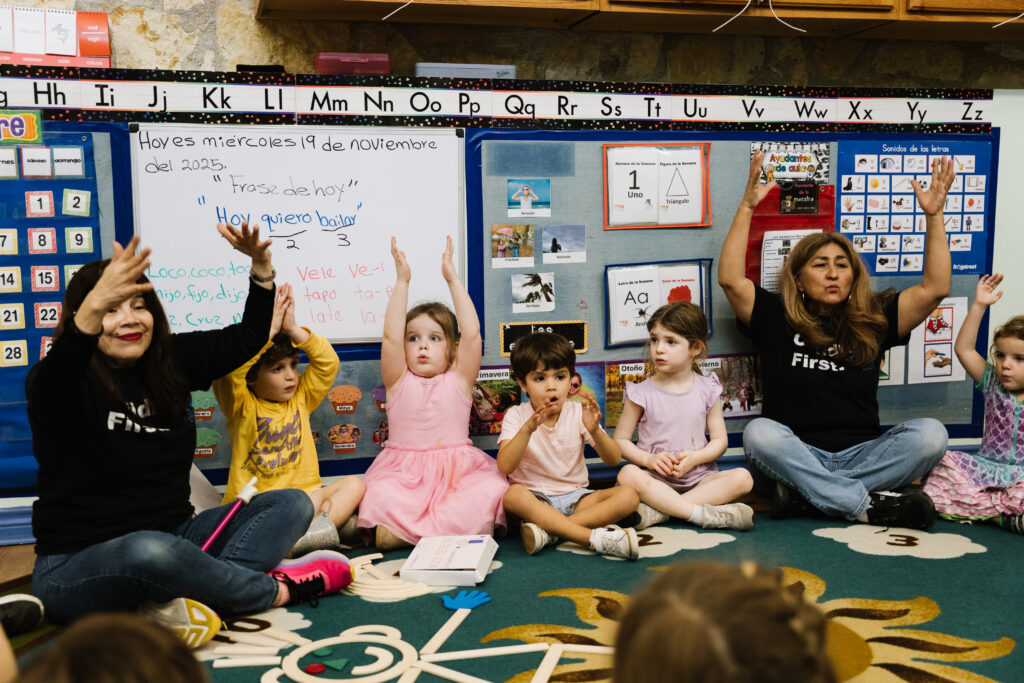
Every day at YPW, children learn through Spanish. Our balanced program blends strong core instruction with hands-on exploration so students build knowledge, creativity, and confidence—en español.
What families can expect
True immersion
True immersion Native/near-native educators model real-life Spanish all day.
Balanced curriculum
Balanced curriculum - Literacy
- Math
- STEAM
- Music & Movement
- Social-Emotional.
Small groups & centers
Small groups & centers Lots of talk time, feedback, and choice.
Whole-child growth
Whole-child growth Curiosity, critical thinking, collaboration, and kindness.
Social-Emotional
YPW teachers creates lessons around the core values, based on five benchmarks: respect, responsibility, cooperation, communication, and self-management. These terms form a common language used throughout the School, which helps clarify communication with parents about their child’s growth and development.
Throughout their time at YPW, students get opportunities to develop confidence, responsibility, and respect. From maintaining the garden and watering the plants, to the daily jobs around the classroom that all students do, the YPW community will encourage pride in a job well done and respect for others’ work.
Students are exposed to social emotional concepts and values daily, using picture books, journaling, role-playing, group discussion, and/or cooperative activities. Students are taught to celebrate each other’s unique qualities and to respect each other’s differences. Teachers establish classroom norms to promote equity and inclusion and to teach students how to disagree respectfully. Students learn to become respectful listeners, problem-solvers, and independent thinkers through play, stories, cooperative activities, and hands-on lessons.
Reading
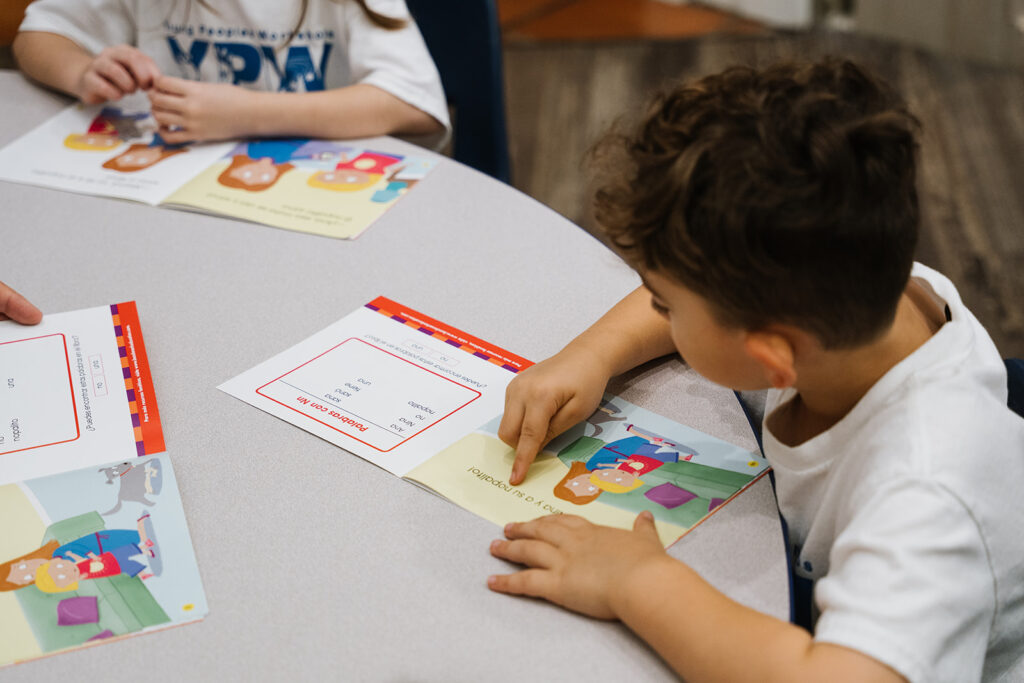
Children in our school develop a love of reading in many ways. Our intentional and individualized approach to literacy builds a strong foundation of skills.
Because children don’t all learn on the same day the same way, we work with students where they are, set developmentally appropriate goals, and equip students to meet those goals and push to the next one. Formal assessments and student observation are used to assess “just-right” reading levels and to ensure that students are meeting benchmarks and stretching themselves with book choices.
We blend the explicit instruction of skills with a language-rich environment for children to engage authentically with a variety of texts. Students learn reading through read-alouds and modeling of skills one-on-one instruction, small group work, and whole group lessons.
Starting in Kindergarten, classes visit the Children’s Library each week to engage with stories, learn about various genres, and practice comprehension skills. Students love to peruse the rich supply of tittles and choose their next literary adventure.
Beginning Years
Print carries meaning
Playing with sounds
Symbol recognition
Retelling stories to make meaning

Exposure to books
Early Years

Matching sounds + symbols

Sounding out words

Identifying sight words

Retelling stories to build comprehension

Developing phonemic awareness skills
Middle Years

Decoding

Reading to learn

Expanding sight words

Developing literal comprehension skills

Reading stamina

Moving away from text with illustrations
Later Years

Refining fluency

Building inferential comprehension skills

Supporting thinking with evidence

Determining theme

Expanding vocabulary
Writing
Becoming a writer starts with storytelling.
From our two-year olds through our 5th graders, students learn to discover their voice. They learn that their words have meaning and putting them to paper gives them power. Whether they are dictating their thoughts to a teacher, engaging in a dramatic play with their friends, or typing their notes from an interview, students of all ages are developing their skills to become competent and compelling writers.
Because writing is a process and an exercise in communication, we provide the students with authentic opportunities to engage with an audience and receive feedback from peers and teachers during activities such as “The Share Bag” or an “Author’s Circle”. At every level, we work on the mechanics of writing.
Students also learn to revise and edit through the writing workshop model across multiple genres. This process allows students to discover and trust their voice.
And finally, inspiration often comes from seeing examples that capture the imagination. To this end, teacher use literature as mentor texts as examples of quality writing.
Beginning Years

mark making

letter strings

retelling of personal experiences

dramatic play
Early Years

matching sounds + symbols

writing letters and numbers

expressing thoughts with words and pictures

using appropriate beginning and ending sounds of words

early sentence writing

introduction to punctuation
Middle Years

structure of a story

exploring craft, dialogue, and interesting language

beginning paragraph writing

writing for a wider audience

capitalization rules

spelling patterns
Later Years

sentence complexity

beginning essay structure and development

organization

writing to inform others

Practice with writing mechanics

Dictionary skills

Prefixes, suffixes, root words

Expanding vocabulary
Math
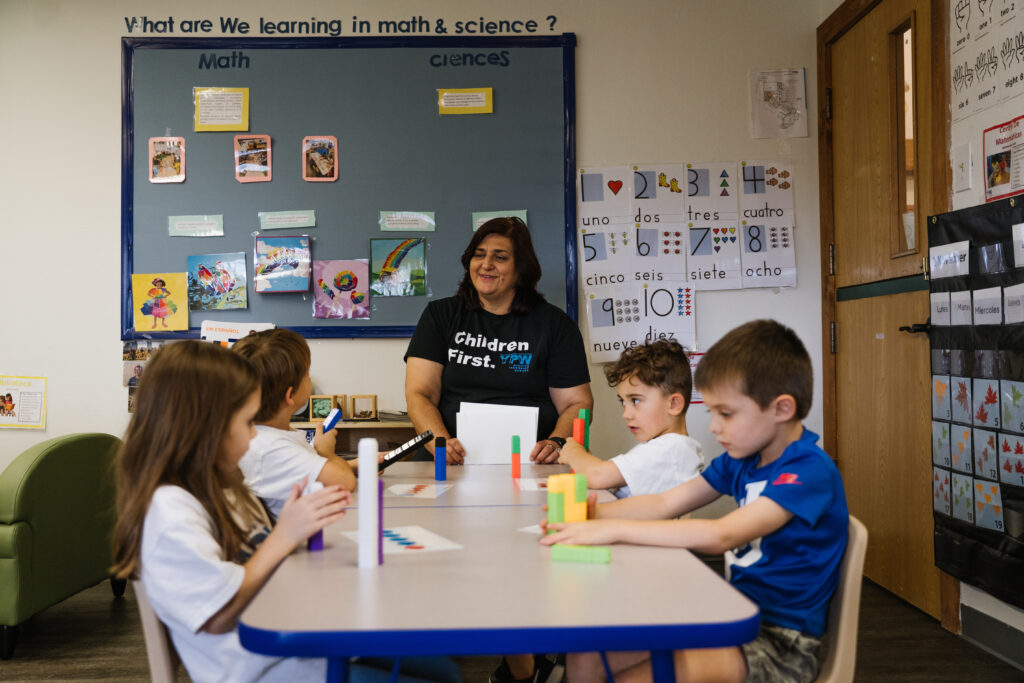
The mathematic program at YPW focuses on developing a deep understanding of mathematical concepts, proficiency with key skills, and the ability to solve complex and novel problems.
With our youngest children, we start their mathematical journey by guiding and helping to make connections using activities such as cooking, counting, designing and building, and playing games. This work continues on during their time in the Elementary School where we blend:
- direct instruction
- structured investigation
- open exploration
Students are engaged in math throughout the day. They play math games and participate in math-focused daily activities where they discover and explore math principles either guided by teachers, cooperatively with peers, or independently. Students also work through classroom challenges that teachers create to reinforce concepts and expand student’s mathematical facility. And because the real world isn’t siloed, we incorporate geometry, measurement, fractions and problem solving into our specialist’s classes in authentic and meaningful ways.
Whether we are identifying patterns, measuring ingredients, or creating maps, math is all around us.
Beginning Years

beginning number sense

1-on-1 correspondence

symbol knowledge

comparisons

matching
Early Years

subitizing

concepts of addition and subtraction

number relationships

using mathematical tools

basic geometry skills
Middle Years

building fluency with addition and subtraction

introduction to multiplication and division

expanding knowledge and place value

fractional pieces of numbers

understanding of rectangular arrays and area
Later Years

introduction to proportional reasoning

developing procedural fluency with all four operations

analyzing and classifying geometric figures

understanding volume

finding equivalent fractions
Social Studies
Social Studies at YPW develops global, cultural, environmental, and societal awareness. Students build geographic literacy, explore historical events, and learn about diverse cultures through an integrated, inquiry-based curriculum that is closely connected to language arts.
Learning moves beyond memorization as students engage in discussion, projects, and real-world connections that encourage critical thinking and deeper understanding. School trips and hands-on experiences further enrich the curriculum.
Instruction is guided by six essential questions that help students make sense of their world:
Who am I, and how do my experiences shape my understanding of the world?
How do people and societies change over time?
How does geography influence how people live and interact?
How are communities and governments formed and organized?
How does the past help us understand the present and shape the future?
What responsibilities do we have as members of local and global communities?
Through this approach, students develop curiosity, empathy, and the skills needed to think critically and engage thoughtfully with the world around them.
Science
On a-day-to-day basis, our young students immerse themselves in scientific inquiry. Building the foundations of scientific and reasoning is an essential part of YPW education. Play-based exploration and learning nurtures a lifelong love for inquiry and discovery encouraging creativity, critical thinking and a sense of wonder about the world.
Beginning Years

sensory exploration

nature-based exploration

exploration of the physical world (rocks, bugs, plants, bones, etc.)

discovery with the everyday (cooking, seeds + plants, fish tanks)
Early Years

multisensory experiences

introduction of scientific tools

practical skills and observations

exploration of the natural world: nurturing a lifelong love for inquiry and discovery
Middle Years

enhanced observation

data collection

formation of hypothesis

conducting simple experiments
Later Years

critical thinking

real world challenges

experimental design

deep understanding of scientific principles
STEM + Design Thinking
STEM (Science, Technology, Engineering and Math) classes emphasize creative use of technology tools to develop collaboration and innovation through design thinking, electronics, coding, engineering and digital citizenship. Our goal is to provide a foundation of skills and awareness that will inspire students and allow them to be creators, not just consumers of technology.
In the beginning years, students work with peers and teachers on the concepts of design and engineering. Technology, such as projectors, levers + pulleys, and microscopes are used to extend student’s thinking and test their theories about the world around them.
Beginning Years

design thinking: building with blocks and natural materials

storytelling: dramatic play

collaboration

trial + error

adhesion + cohesion
Early Years

design thinking: simple machines and inventions

storytelling: introduction to coding

balance between technology use and active play
Middle Years

design thinking: creative programming with robots

storytelling: begin video production and introduction to coding

digital citizenship: awareness about participating with kindness in online communities
Later Years

design thinking: 3D printing

storytelling: intermediate video production and begin website design

digital citizenship: awareness of online privacy and participating in online communities with kindness

creative leadership through news program
Visual Arts
The art studio is a place for children to explore and discover through materials and play. Through self directed exploration and guided instruction, they learn to think like artists, developing problem-solving skills, resilience, and a deeper understanding of themselves and their world.
Our visual arts curriculum is design to support each student’s unique artistic journey, encouraging them to experiment, take risks, and reflect on their artistic process and outcomes.
Students become storytellers, as well as researchers. The child’s process is valued over any final product and the environment encourages experimentation, spontaneous creativity, and expression. Our intentional art curriculum helps to cultivate self-awareness, creativity, curiosity, confidence and wonder.
We teach for artistic behavior, which can be summed up with a powerful three-sentenced focus:
What do artists do?
The child is the artist
The classroom is child’s studio
Beginning Years

space

fine motor skill development

storytelling

descriptive language
Early Years

line, shape, color, pattern and form

develop craft

collaborate and connect

stretch and explore
Middle Years

style, theme and customization

balance + movement

envisioning + executing a concept

document and reflect
Later Years

composition, value, perspective and illusion

express creative ideas

understand art worlds

engage and persist
Music & Movement and PE
We prepare our students to be physically and mentally active, fit, and healthy for life. Our goals are to have fun while participating in sport and skill activities. We stress the importance of fully participating, positive encouragement, and continued improvement in all of the sports and games that we play.
Beginning Years

balance

bilateral movements

jumping + climbing

alternating feet
Early Years

hand-eye coordination

eye-foot coordination

cooperative games + intro to team sports

spatial awareness
Middle Years

sportsmanship + fair play

refinement of locomotor skills and speed

complex team sports

game strategy
Later Years

team building

rules + procedures

tournament play

refine body control skills
How we teach

Model → Guide → Independence (gradual release)

Workshop & learning centers with targeted small groups

Assessment for learning (quick checks, conferences, rubrics)

Differentiation for beginners to advanced speakers
Partnering with families

Weekly highlights & simple at-home prompts (en español)

Family showcases of student work